
Garage Door Maintenance & Tune-Up
A pre-winter inspection and adjustment that catches wear before a January morning does.
View serviceGarage doors get louder gradually, which is why households usually stop noticing until a neighbour mentions it or a bedroom above the garage starts hearing every trip. The useful skill is telling the sounds apart.
Match the sound to the part. Grinding or rumbling that tracks the door means rollers or shaft bearings; squealing at the joints means dry hinges; a rattle at one spot means a loose bracket or fastener; a bang means a spring has broken and the door should not be used. Lubricate rollers, hinges, bearings and spring coils with a proper garage door product, never the track surfaces, and have anything that grinds, binds or bangs inspected rather than sprayed.
A garage door in good order makes a low, even rumble and nothing else. Anything sharper than that is a component reporting on itself, and the type of sound narrows the cause down considerably before anyone picks up a tool. A rumble that rises and falls with the door and follows it up and down is usually the rollers, whose bearings have picked up grit and stopped rolling freely. A rhythmic squeal at the section joints is dry hinges. A metallic groan concentrated above the opening is the torsion springs rubbing or the shaft bearings at either end. A rattle at one particular point in the travel is often a loose track bracket or a fastener that has vibrated out. A single loud bang, however, is different from all of these and should be treated as an emergency: that is the sound of a spring letting go, and the door immediately becomes its full weight with nothing holding it. Work through the checks below with the door stationary wherever possible, and use your ears deliberately: stand inside, run the door once, and locate the sound by where it comes from and when in the travel it happens rather than trying to fix everything at once.
Start at the top. The early checks are the most common causes and need no tools.
Stand well inside the garage with the door in full view, run one complete cycle, and note whether the noise follows the door, stays above the opening, or happens only at one height. Note also whether it is metallic, rubbery or a rattle of loose hardware.
What it means: Sound that follows the door points to rollers and hinges; sound fixed above the opening points to springs and bearings.
With the door closed, look at each roller where it sits in the track. Worn ones often show a flat spot, visible play on the stem, or a bearing race that has lost its grease and picked up grit. Unsealed builder-grade rollers are the usual noise source on a subdivision door of ten years or more.
What it means: Flat spots, wobble or dry bearings mean the rollers are the noise and replacement is the fix.
Look along the section joints for hinges that are dry, cracked around the fastener holes, or working visibly as the door moves. Check track brackets and the flag angles at the top of the vertical track for screws that have backed out. Do not tighten anything on the bottom brackets.
What it means: Cracked hinges or loose track fasteners explain a rattle and need correcting before the door is used heavily.
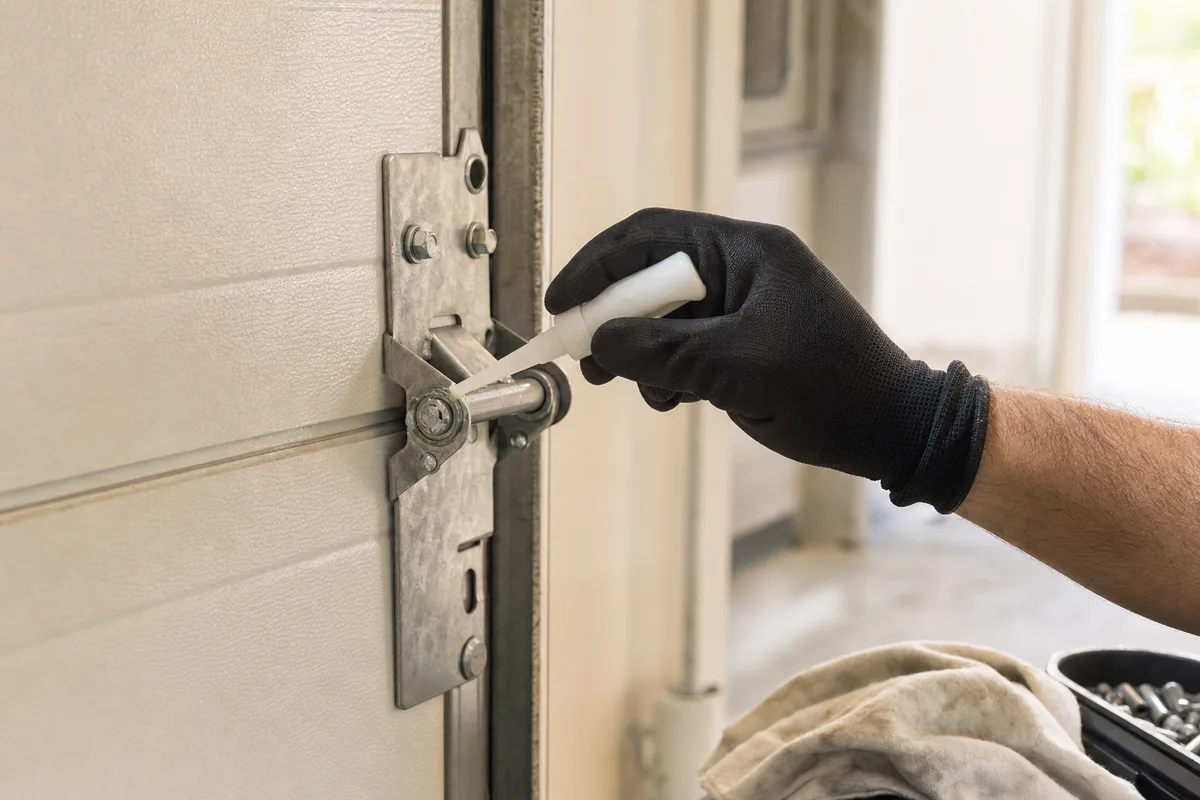
Apply a garage door lubricant or a light lithium product to the roller bearings, the hinge pivots, the bearings at each end of the torsion shaft, and lightly along the spring coils. Leave the track running surfaces clean and dry, and wipe away excess so it does not collect salt and grit.
What it means: A noise that disappears with correct lubrication was friction, and the improvement should last months, not days.
With the door closed, pull the release cord to disconnect the opener, then lift the door by hand to about waist height and let go. A balanced door stays roughly where you left it. Reconnect the opener afterward with the door closed.
What it means: A door that drifts down or shoots up is out of balance, and the opener straining against it is part of the noise.
A single loud bang from the garage means stop. That is the signature of a torsion spring failing, and if the door was open at the time it is being held by an opener never designed to carry it. Keep everyone out from under it, do not pull the release cord, and do not send another command. Never lubricate, adjust or investigate a spring by hand, and never remove a bottom bracket to get at a noisy roller: both stay under full tension with the door in any position. Grinding accompanied by binding or a door that judders in one spot should also take the door out of service rather than earn another spray of lubricant.
Two local details make noise worth acting on here. The first is winter debris: Newmarket averages 122.2 centimetres of snow a season across roughly 32 snowy days, so sand, salt and slush are carried into the lower track for months, and that grit is what destroys unsealed roller bearings. The second is where the doors are. Armitage is about 25 percent row housing and Summerhill Estates about 34 percent, which puts a lot of single-width garages directly beneath bedrooms in a town whose population density is among the highest of any Ontario municipality. On those houses, sealed rollers and properly serviced hinges are not a refinement, they decide whether the door can be used at six in the morning.
Fill out the form and we'll confirm your appointment by email.
These guides are written for Newmarket homes. If the fix is beyond a homeowner check, we work everywhere inside this area.
Map data © Google. Pin shows the service area, not a walk-in location — all work is done at your home.

A real callout, not stock imagery.
A sectional door pulled off its tracks, taken down and supported on site so it could be checked and re-hung safely — photographed on the job.
