Home All Services
All 10 Services
Emergency Garage Door RepairGarage Door Spring RepairGarage Door Spring ReplacementGarage Door Cable RepairGarage Door Roller & Track RepairGarage Door Opener RepairGarage Door Opener InstallationGarage Door Panel ReplacementNew Garage Door InstallationGarage Door Maintenance & Tune-Up All Service Areas
All 16 Neighbourhoods
Historic DowntownCentral NewmarketQuaker HillBristol-LondonGlenway EstatesCrossland GreenArmitageHuron HeightsLeslie ValleyGorham-College ManorSummerhill EstatesStonehaven-WyndhamCopper HillsWoodland HillBogartYonge & Davis Corridor
Troubleshooting Guides
Diagnose a Problem
Door won't closeLoud noiseBroken spring signsFrozen shutRemote not workingOff track About Book Service

Garage Door Maintenance & Tune-Up Newmarket

A pre-winter inspection and adjustment that catches wear before a January morning does.

Vertical track, bottom roller bracket and lift cable at the base of a garage door, with the wall-mounted safety sensor beside the opening
What's involved

Garage Door Maintenance & Tune-Up

Maintenance is the cheapest work a garage door ever gets, because nearly every expensive failure gives warning first. A tune-up is a defined sequence rather than a spray-and-go: balance tested by hand with the opener disconnected, spring condition and cable condition inspected, rollers and hinges checked and lubricated properly, track alignment and bracket fasteners verified, photo eyes and the safety reverse tested, seals checked against the slab, and the opener's force and travel limits reviewed against how the door actually behaves now.

  • Diagnosed before quotedWe identify the actual fault rather than replacing parts on assumption.
  • Confirmed by emailSubmit the form and we reply with your appointment window and details.
Symptoms

Signs You Need This Service

  • The door has grown gradually noisier over a season.
  • It has never been serviced since it was installed.
  • The opener seems to work harder than it used to.
  • Daylight is visible along the bottom seal.
  • Winter is coming and the door already hesitates in the cold.

Repair or replace?

An annual service is a reasonable baseline, and twice a year suits households that use the garage as the main entrance to the house. The value is not the lubrication, it is the inspection: a spring with a hairline crack, a cable with two broken strands or a track bracket working loose are all cheap to address and expensive to ignore. Maintenance does not make a spring immortal, since springs are rated in cycles and reach the end of that rating regardless. What it does is let the household choose when a component gets replaced instead of finding out on the coldest morning of the year.

Not sure this is your problem?

Work through the symptom first — some of these turn out to need no technician at all.

Root causes

What Actually Goes Wrong

Fasteners working loose

Every cycle vibrates the assembly. Hinge screws, track brackets, flag angles and the opener's mounting hardware all back out over time, letting the door move in ways it should not.

Lubrication gone or wrong

Factory lubricant dries out, and household oil or the wrong spray attracts grit and makes things worse. Rollers, hinges, bearings and spring coils each want the right product in the right place.

Slow loss of balance

Springs relax gradually, so the door gets heavier by degrees and nobody notices until the opener is straining. A hand test catches it while it is still an adjustment.

Seals and drainage failing

A hardened or torn bottom seal lets water and snow reach the threshold, where it freezes the door down, corrodes bottom brackets and pits cable at its anchor point.

Local conditions

Why This Matters in Newmarket

Timing is the local point. Newmarket averages 122.2 centimetres of snow a season with about 31 centimetres in January alone, its snowiest month, spread over roughly nine snowy days that month, so an October or November service catches problems before the door has to work in the cold. The mechanism that does the damage is melt and refreeze at the threshold: a mild afternoon puts water at the base of the door, a night at minus eleven turns it to ice, and the door is then restrained at the bottom while the opener pulls from the top. No reliable count of those cycles is published for Newmarket, so we will not invent one, but the pattern repeats through every local winter.

Safety

What to Handle Yourself

Testing balance with the opener disconnected, wiping sensor lenses, clearing grit from the lower track and testing the safety reverse against a piece of timber on the floor are all reasonable homeowner tasks and worth doing twice a year. What is not: adjusting spring tension, tightening or removing bottom brackets, replacing rollers on a loaded door, or raising force settings to make a stiff door close. If a tune-up finds a cracked spring, a frayed cable or a bent track, the door should stop being used until that is dealt with rather than run gently in the meantime.

The visit

How We Work Through It

  1. Balance and spring check

    The opener is disconnected and the door lifted by hand and tested at several heights, then springs are inspected for coil gaps, corrosion and correct sizing for the door.

  2. Hardware inspection and tightening

    Hinges, rollers, bearings, drums, cables, brackets, track alignment and every fastener are checked, tightened where safe, and anything worn is identified and reported rather than left.

  3. Correct lubrication

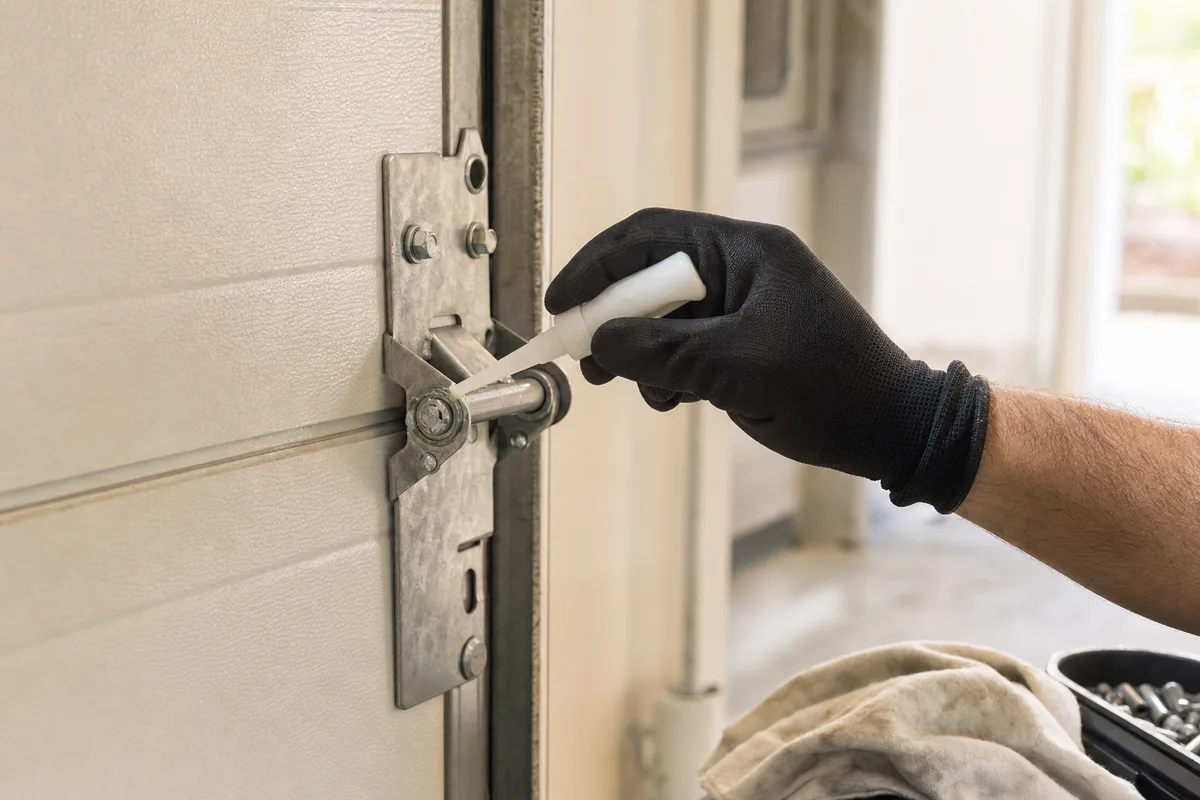
    Rollers, hinges, bearings and spring coils are lubricated with the appropriate products; the track running surfaces are cleaned rather than greased, since grease there just collects grit.

  4. Safety and opener verification

    Photo eye alignment, the safety reverse against an obstruction, force and travel limits, the manual release and the seals are all tested, and the household is shown the reverse test to repeat itself.

Related services

You Might Also Need

Centre bearing bracket and the end of a torsion spring on a residential garage door, the shaft seated in its bearing and the bracket bolted back to the header

Garage Door Spring Repair

Tension and balance reset on intact springs so the door stops fighting the opener.

View details
Vertical track, bottom roller bracket and lift cable at the base of a garage door, with the wall-mounted safety sensor beside the opening

Garage Door Roller & Track Repair

Worn rollers, bent track and loose brackets corrected for quiet, guided travel.

View details
Chain-drive opener mounted to the exposed rafters of an unheated detached garage, with the rail, chain and emergency release cord visible

Garage Door Opener Repair

Boards, limits, drive parts and safety sensors diagnosed before anything is swapped.

View details
Questions

Garage Door Maintenance & Tune-Up FAQs

How often should a garage door be serviced?
Once a year covers a normally used door, and twice a year is sensible where the garage is the household’s main entrance and the door cycles six or eight times a day. In this climate the most useful single appointment is in autumn, before the door has to work through a winter of cold, grit and meltwater at the threshold. Between services, testing the safety reverse and looking along the bottom seal for daylight takes a couple of minutes and catches a surprising amount.
What can I safely do myself between visits?
Quite a lot. Wipe the photo eye lenses and check they are aimed at each other, clear grit and salt out of the lower track with a cloth, test the safety reverse by laying a length of timber flat on the floor where the door lands, and disconnect the opener with the door closed to test the balance by hand. Anything involving spring tension, bottom brackets, cables or replacing rollers on a loaded door should be left alone. Those are where people get hurt.
Which lubricant should I use, and where?
A garage door lubricant or a light lithium-based product, applied to the roller bearings, the hinge pivots, the bearings at each end of the torsion shaft and lightly along the spring coils. Do not grease the track running surfaces, because grease there simply holds grit and increases drag. Avoid general-purpose penetrating sprays as a lubricant; they clean and displace but do not stay. Wipe up the excess, since anything left on the surface will collect dust and salt through the winter.
Will maintenance stop my spring from breaking?
No, and anyone claiming otherwise is overselling it. Springs are rated in open-and-close cycles and will reach the end of that rating whatever you do, though correct lubrication and a balanced door do help them get there rather than fail early. What maintenance genuinely buys is warning. A hairline crack, corrosion in the coils, or tension that will not hold an adjustment are all visible to someone looking for them, which turns a sudden failure into a scheduled replacement.

Book Garage Door Maintenance & Tune-Up

Fill out the form and we'll confirm your appointment by email.

We confirm every request by email, usually the same day it arrives.

  • Proudly Canadian
  • Same-day service available
  • 16 Newmarket communities
  • Every request confirmed by email
Request received. We'll email you a confirmed time window shortly.
Service area

Where We Work

Garage Door Maintenance & Tune-Up is available across every Newmarket neighbourhood inside the area below.

Map data © Google. Pin shows the service area, not a walk-in location — all work is done at your home.

Sectional garage door dropped off its tracks and leaning inward, held on a stepladder during a night call-out, with the driveway lit beyond the opening
From the tools

A real callout, not stock imagery.

A sectional door pulled off its tracks, taken down and supported on site so it could be checked and re-hung safely — photographed on the job.