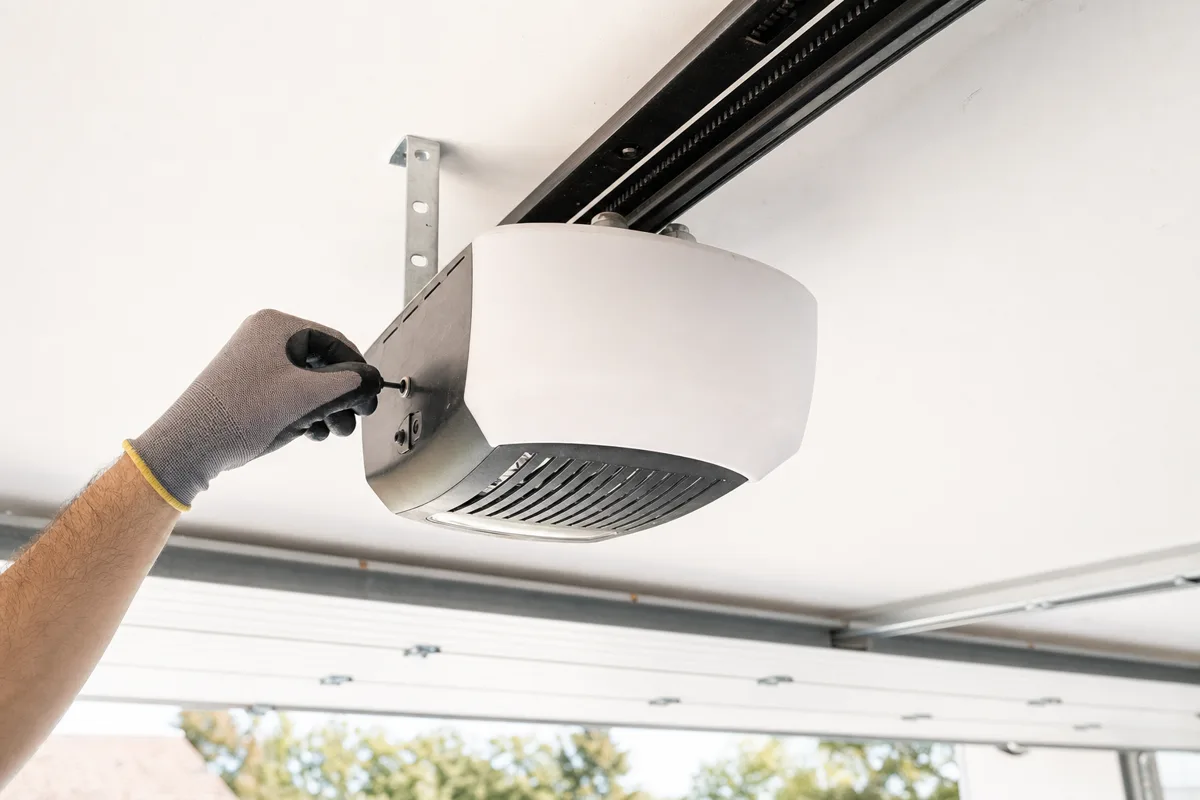

Garage Door Opener Repair
Boards, limits, drive parts and safety sensors diagnosed before anything is swapped.
View serviceThe door starts down and comes straight back up. Or it stops a hand-width off the slab and sits there. Both behaviours usually mean the opener is being told to stop, not that it has lost the strength to finish.
Clear the floor line under the door, then wipe both photo-eye lenses and check their indicator lights and alignment. A broken or dirty beam is the most common single cause of a door that reverses while closing. If the beam checks out, look for ice bonded to the bottom seal, a roller sitting crooked, or a bent track, and stop using the door if the travel is uneven. Do not increase closing force to make a resistant door shut.
A modern opener will only complete a closing cycle if two conditions hold: the photo-eye beam across the bottom of the opening is unbroken, and the resistance it meets on the way down stays inside the force it has learned. Break either condition and the unit reverses, which is the safety system working as designed rather than a fault in itself. That makes the reversal a piece of diagnostic information worth reading carefully. Work through the checks below in order, make one closing attempt after each, and watch from a spot where both bottom corners of the door are visible. Note the exact height at which the door stops, because a door that reverses on contact with the floor and a door that reverses halfway down are telling you about different things. Two things not to do: do not hold the wall button down to force the door through a cycle it is refusing, and do not raise the closing-force setting to overpower resistance. Both hide the cause, and if the cause is a dragging roller, a bent track section or ice at the threshold, hiding it is how a cheap repair becomes an expensive one. If the door is tilting, scraping, or one cable has gone slack, stop testing entirely: that is mechanical and no adjustment will address it.
Start at the top. The early checks are the most common causes and need no tools.
Move bins, snow shovels, sports gear and floor mats well clear of the opening, then look along the whole length of the bottom seal for a stone, a curled mat edge, a frozen ridge of slush or a stick. Then make one closing attempt and note precisely where the door stops.
What it means: A clean close after clearing the threshold means it was an obstruction, and nothing further is needed.
The sensors sit low on opposite tracks, usually within a hand-span of the floor. Wipe each lens with a dry cloth, clear cobwebs and stored items out of the beam path, and check that neither bracket has been knocked askew by a bike or a vacuum. Compare the indicator lights against what that model calls normal.
What it means: A flickering, dark or wrong-coloured sensor light puts the fault in the safety circuit rather than the door.
With the door up, look at the slab where the bottom seal lands and at the seal itself. A thin sheet of refrozen meltwater will bond rubber to concrete convincingly. If you find ice, do not run the opener against it; clear it mechanically with warm water and a plastic scraper, never a heat gun or a torch.
What it means: Ice at the threshold explains a door that will not seat, and the opener should stay off until it is cleared.
With the full door in view, send one closing command from the wired wall button rather than a remote. If it closes only while you hold the button down, treat that as the opener telling you the safety circuit is unhappy, not as a workaround to keep using. Also check whether the control lock has been switched on by accident.
What it means: Closing only under held pressure means the photo-eye circuit needs attention before the door is used normally.
Once the door is safely closed, look for a roller sitting at an angle in its track, a crease or bow in the vertical track, a lift cable that has gone slack near the drum, and whether the bottom gap is even across the width. Do not touch springs, cables, drums or the bottom brackets.
What it means: Uneven travel, a slack cable or damaged track is a mechanical repair, so stop using the door.
Stop using the door if it closes crookedly, catches at a particular point, makes a hard metallic sound, or shows a cable hanging loose. Do not adjust the opener force or travel limits to push past that resistance, and never tape over a photo eye or aim both sensors at the same wall to defeat the beam: that circuit is what stops a heavy panel on a child or a pet. Do not touch torsion springs, winding cones, cables under tension, cable drums or the bottom brackets, which stay loaded even when the door is open. If the door can be closed safely, leave it closed, keep the opening clear and send the details through the form.
This is an inland town and a cold one: the local station records a January daily mean near minus 7.4 degrees, a mean daily low around minus 11.1 and about 31 centimetres of snowfall in January alone. That combination puts slush and salt spray right where the photo eyes are mounted, a few centimetres off the slab, and it is why the threshold check matters as much as the sensor check here. Where the garage sits at the bottom of a sloped or pie-shaped driveway, as many do in Quaker Hill and Gorham-College Manor, afternoon meltwater runs to the door and freezes there overnight. During a snow event, a cleared threshold and a wiped lens beat repeated remote presses every time.
Fill out the form and we'll confirm your appointment by email.
These guides are written for Newmarket homes. If the fix is beyond a homeowner check, we work everywhere inside this area.
Map data © Google. Pin shows the service area, not a walk-in location — all work is done at your home.

A real callout, not stock imagery.
A sectional door pulled off its tracks, taken down and supported on site so it could be checked and re-hung safely — photographed on the job.
