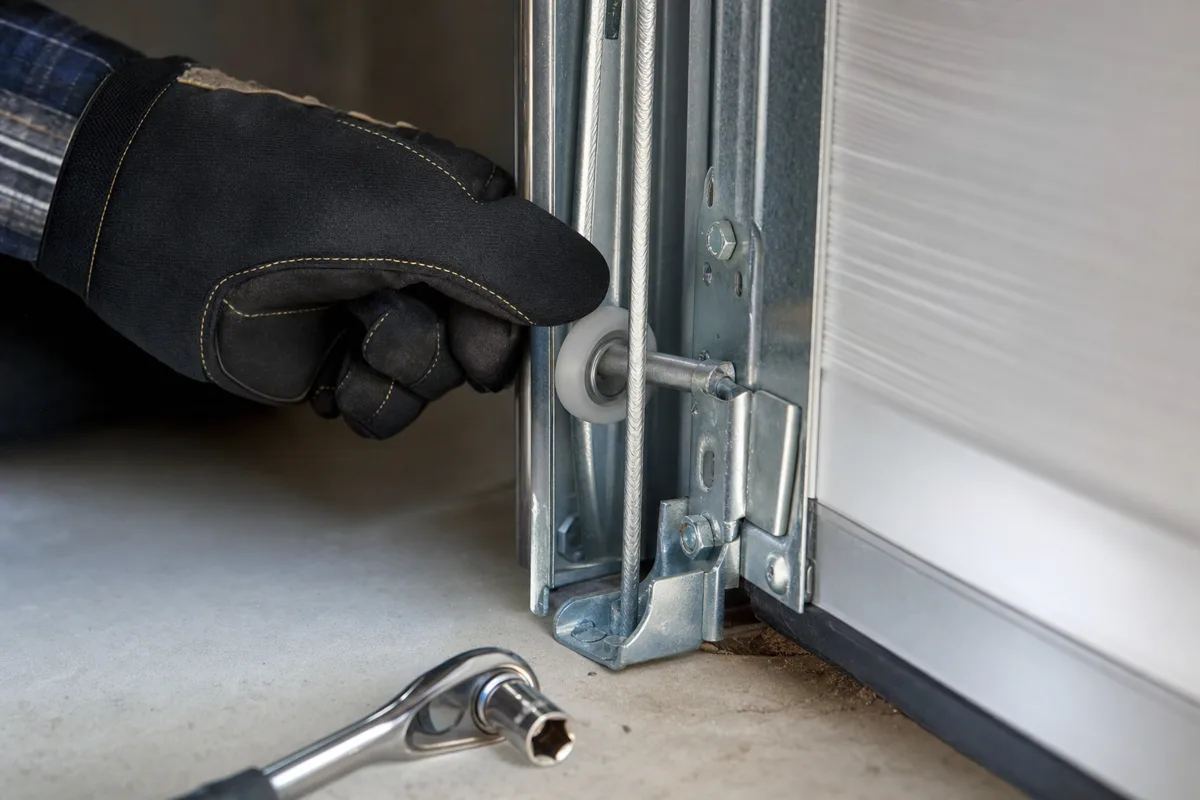

Garage Door Roller & Track Repair
Worn rollers, bent track and loose brackets corrected for quiet, guided travel.
View serviceA door off its track feels sudden, but it almost never is. Something was already wrong, and one cycle finally exceeded what the guide path could hold.
Stop using the door and cut power to the opener at the outlet so nobody sends a command. Do not try to lever, lift or re-seat the door, and do not stand under it. Move vehicles and people clear of the opening. Look for the cause from a safe distance: a slack or broken cable, a bent track section, a roller out of its channel, an impact point. Then report those details through the form and leave the door where it is.
The rollers on a garage door ride in a steel track that guides the panel through the vertical run, around the radius, and back along the horizontal. Take a roller out of that path and the door is no longer a controlled mechanism: it is a heavy panel connected to a tensioned spring system with one corner unsupported. That is why the correct response is to stop, not to try to persuade it back in. The causes are consistent. A seized or collapsed roller drags at one point. A bent or misaligned track section changes the roller gap. Track brackets vibrate loose and let the track shift under load. A lift cable snaps or unwinds from its drum and one side of the door drops. An obstruction stops one corner while the opener keeps driving the other. Impacts accelerate all of it. The warnings are equally consistent, and they are the reason to take judder, grinding and hesitation seriously: a door that hesitates at the same point every time is describing the place where it will eventually come out. The checks below are about assessing safely and gathering the details worth reporting, not about re-railing anything.
Start at the top. The early checks are the most common causes and need no tools.
Unplug the opener or switch off its outlet so no remote, keypad or wall button can send a command. Move vehicles out of the opening if that can be done without passing under the door, and keep children and pets away from the garage entirely.
What it means: A door out of service and an isolated opener is the safe baseline before anything is inspected.
From several steps back, identify which corner has come out, whether a lift cable is slack or hanging, whether a track section is visibly bent or pulled away from the wall, and whether a roller has left its channel. Photograph it if you can do so safely.
What it means: Identifying the failed corner and whether a cable is involved tells us what to bring on the first visit.
Judge whether the door is resting in a position that is holding, or whether it is under tension and liable to move. Do not test this by touching it. A door part way up with an unsupported corner is the least stable arrangement there is.
What it means: An unstable door part way open should be treated as urgent, with the opening kept clear until someone attends.
Think back over recent weeks: grinding that followed the door, a judder at the same height every time, a rattle at one point, a recent bump from a vehicle or a bin. These narrow down the original fault and are worth writing down before you forget them.
What it means: A remembered judder point or recent impact usually identifies the component that caused the derailment.
Where the door cannot be closed, secure the garage as best you can at ground level, keep the opening clear, and send the details through the form: which corner, whether a cable failed, approximate door size, and how the garage is reached.
What it means: Accurate details mean the repair arrives with the right parts rather than needing a second visit.
Do not attempt to re-rail a garage door. The panel is heavy, one corner is unsupported, and the spring system is still under full tension regardless of where the door is sitting. Do not lever a roller back into its channel, do not remove a bottom bracket, and do not touch cables, drums or springs. Do not pull the emergency release cord on a door that is up and unsupported, because it can come down fast and unevenly. Do not run the opener to see whether the door will straighten itself out; each attempt drags more hardware out of position and can turn a track and roller job into a bent-section job.
Two local conditions feed this failure here. The first is grit: with 122.2 centimetres of snow in an average season and about 32 snowy days, sand and salt spend months in the lower track, and that is what kills unsealed rollers and starts the drag that ends in a derailment. The second is geometry. The Old Town around Main Street South has compact nineteenth-century lots with detached rear garages reached by narrow laneways and side drives, which makes for tight turns and more contact between vehicles and vertical track than a wide subdivision driveway produces. Gorham-College Manor’s cul-de-sacs and pie-shaped ravine lots have the same effect. An impact that seems minor at the time is the classic precursor.
Fill out the form and we'll confirm your appointment by email.
These guides are written for Newmarket homes. If the fix is beyond a homeowner check, we work everywhere inside this area.
Map data © Google. Pin shows the service area, not a walk-in location — all work is done at your home.

A real callout, not stock imagery.
A sectional door pulled off its tracks, taken down and supported on site so it could be checked and re-hung safely — photographed on the job.