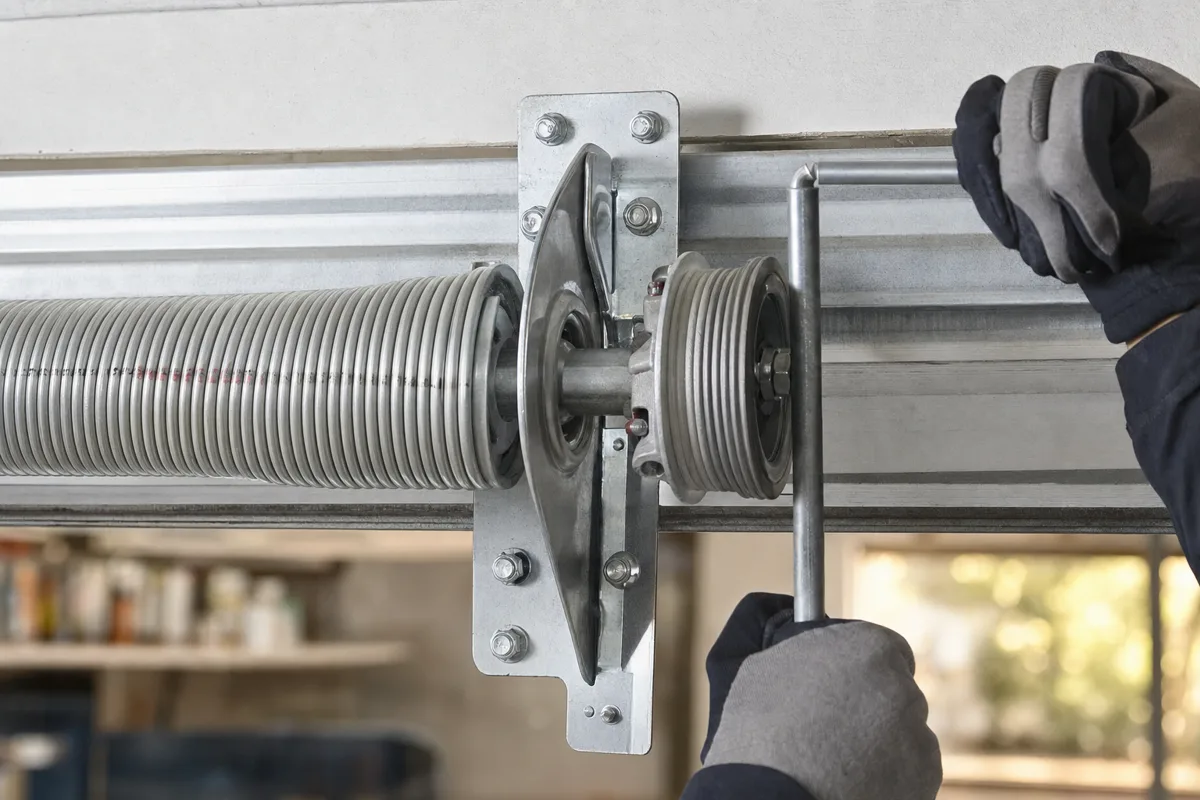

Garage Door Spring Replacement
Broken or fatigued springs replaced as a matched pair and re-tensioned to the door.
View serviceSprings are the only part of a garage door that can hurt someone badly in a moment, and they are also the part households are most likely to misdiagnose as an opener problem.
The clearest sign is a visible gap of a few centimetres in one of the coils above the door, usually preceded by a loud bang. Other signs: the door is suddenly far too heavy to lift by hand, the opener runs and strains without moving it, the door drops fast when released, or it rises crooked. If you see a coil gap or the door will not lift, stop using it and do not pull the release cord while the door is up.
The springs above your garage door, or occasionally the extension springs alongside the tracks, carry essentially the entire weight of the door. The opener does not lift the door; it guides a counterbalanced panel and holds it in position. That single fact explains most of what a failing spring looks like from the household side. When a spring breaks the counterbalance vanishes instantly and the door becomes its full uncounterbalanced weight, which for a double door is a great deal more than most people expect. When a spring merely weakens the effect is gradual: the door gets slowly heavier, the opener works harder, and the household attributes it to a tired motor. The checks below help you tell which of those is happening, and all of them can be done without touching a spring. What they will not do is fix it. A broken torsion spring is not a repair job, and even a sound one holds enough stored energy to break bones if it is released carelessly. The purpose of identifying it is to stop using the door and to give an accurate description of what you found.
Start at the top. The early checks are the most common causes and need no tools.
From a safe distance, with the door closed and the opener not in use, look at the spring or springs on the shaft above the opening. An intact torsion spring is a continuous close-wound coil. A broken one shows a clear separation of a few centimetres where the wire parted. Look, do not touch.
What it means: A visible coil gap is a broken spring, which means the door is out of service until it is replaced.
Springs fail with a bang loud enough that households often think something hit the house or a shelf collapsed in the garage. If that noise was followed by a door that suddenly would not open, the two are connected and no further diagnosis is really needed.
What it means: A loud bang followed by a door that will not lift is a spring failure, not an opener fault.
Only with the door fully closed, pull the release cord to disconnect the opener, then try to lift the door a short way by hand. A door with sound springs feels manageable to one adult. A door with a broken spring feels immovable, or takes real effort and drops the moment you ease off.
What it means: A door that is far too heavy to lift comfortably has lost its counterbalance.
If the door still moves under the opener, watch whether both bottom corners rise together, whether the door pauses or shudders, and whether it drops hard over the last foot. A door lifting crooked has uneven lift, which may be a spring, a cable or both.
What it means: Crooked or shuddering travel means the lift system is unbalanced and the door should not be cycled further.
With the opener disconnected and the door in a raised position you can reach safely, let go and see whether the door holds. A balanced door stays put. Drifting down means the springs have relaxed; creeping up means there is too much tension.
What it means: A door that will not hold its position needs tension work before the opener suffers for it.
Do not attempt to wind, unwind, remove or adjust a torsion spring, and do not use screwdrivers, rebar or drill bits in place of proper winding bars. Do not loosen a set screw on a winding cone. Do not remove a bottom bracket, which stays under full spring tension through the cable even when the door is open. If a spring has broken with the door up, keep everyone clear, do not pull the release cord, and do not send another opener command, because the door may be held only by the drive. If it broke with the door down, leave it down. Send the details through the form and let the door stay where it is.
Spring failures arrive in local clusters because Newmarket built in distinct waves. Quaker Hill went up between 1967 and 1977, Glenway Estates is roughly 54 percent 1981 to 1990 construction, Woodland Hill is about 52 percent 2006 to 2010 with nothing predating 1991, and Copper Hills finished its last large phase in 2017. Doors installed within a few years of one another, in households using the garage as the main entrance, reach the same cycle count at roughly the same time. Add a January daily mean near minus 7.4 degrees and a local record January low of minus 35.2, and a tired spring will usually choose the coldest morning of the winter. If a neighbour has just had one go, a balance check is a reasonable move.
Fill out the form and we'll confirm your appointment by email.
These guides are written for Newmarket homes. If the fix is beyond a homeowner check, we work everywhere inside this area.
Map data © Google. Pin shows the service area, not a walk-in location — all work is done at your home.

A real callout, not stock imagery.
A sectional door pulled off its tracks, taken down and supported on site so it could be checked and re-hung safely — photographed on the job.
