
Garage Door Spring Repair
Tension and balance reset on intact springs so the door stops fighting the opener.
View detailsA pre-winter inspection and adjustment that catches wear before a January morning does.

Maintenance is the cheapest work a garage door ever gets, because nearly every expensive failure gives warning first. A tune-up is a defined sequence rather than a spray-and-go: balance tested by hand with the opener disconnected, spring condition and cable condition inspected, rollers and hinges checked and lubricated properly, track alignment and bracket fasteners verified, photo eyes and the safety reverse tested, seals checked against the slab, and the opener's force and travel limits reviewed against how the door actually behaves now.
An annual service is a reasonable baseline, and twice a year suits households that use the garage as the main entrance to the house. The value is not the lubrication, it is the inspection: a spring with a hairline crack, a cable with two broken strands or a track bracket working loose are all cheap to address and expensive to ignore. Maintenance does not make a spring immortal, since springs are rated in cycles and reach the end of that rating regardless. What it does is let the household choose when a component gets replaced instead of finding out on the coldest morning of the year.
Work through the symptom first — some of these turn out to need no technician at all.
Every cycle vibrates the assembly. Hinge screws, track brackets, flag angles and the opener's mounting hardware all back out over time, letting the door move in ways it should not.
Factory lubricant dries out, and household oil or the wrong spray attracts grit and makes things worse. Rollers, hinges, bearings and spring coils each want the right product in the right place.
Springs relax gradually, so the door gets heavier by degrees and nobody notices until the opener is straining. A hand test catches it while it is still an adjustment.
A hardened or torn bottom seal lets water and snow reach the threshold, where it freezes the door down, corrodes bottom brackets and pits cable at its anchor point.
Timing is the local point. Newmarket averages 122.2 centimetres of snow a season with about 31 centimetres in January alone, its snowiest month, spread over roughly nine snowy days that month, so an October or November service catches problems before the door has to work in the cold. The mechanism that does the damage is melt and refreeze at the threshold: a mild afternoon puts water at the base of the door, a night at minus eleven turns it to ice, and the door is then restrained at the bottom while the opener pulls from the top. No reliable count of those cycles is published for Newmarket, so we will not invent one, but the pattern repeats through every local winter.
Testing balance with the opener disconnected, wiping sensor lenses, clearing grit from the lower track and testing the safety reverse against a piece of timber on the floor are all reasonable homeowner tasks and worth doing twice a year. What is not: adjusting spring tension, tightening or removing bottom brackets, replacing rollers on a loaded door, or raising force settings to make a stiff door close. If a tune-up finds a cracked spring, a frayed cable or a bent track, the door should stop being used until that is dealt with rather than run gently in the meantime.
The opener is disconnected and the door lifted by hand and tested at several heights, then springs are inspected for coil gaps, corrosion and correct sizing for the door.
Hinges, rollers, bearings, drums, cables, brackets, track alignment and every fastener are checked, tightened where safe, and anything worn is identified and reported rather than left.
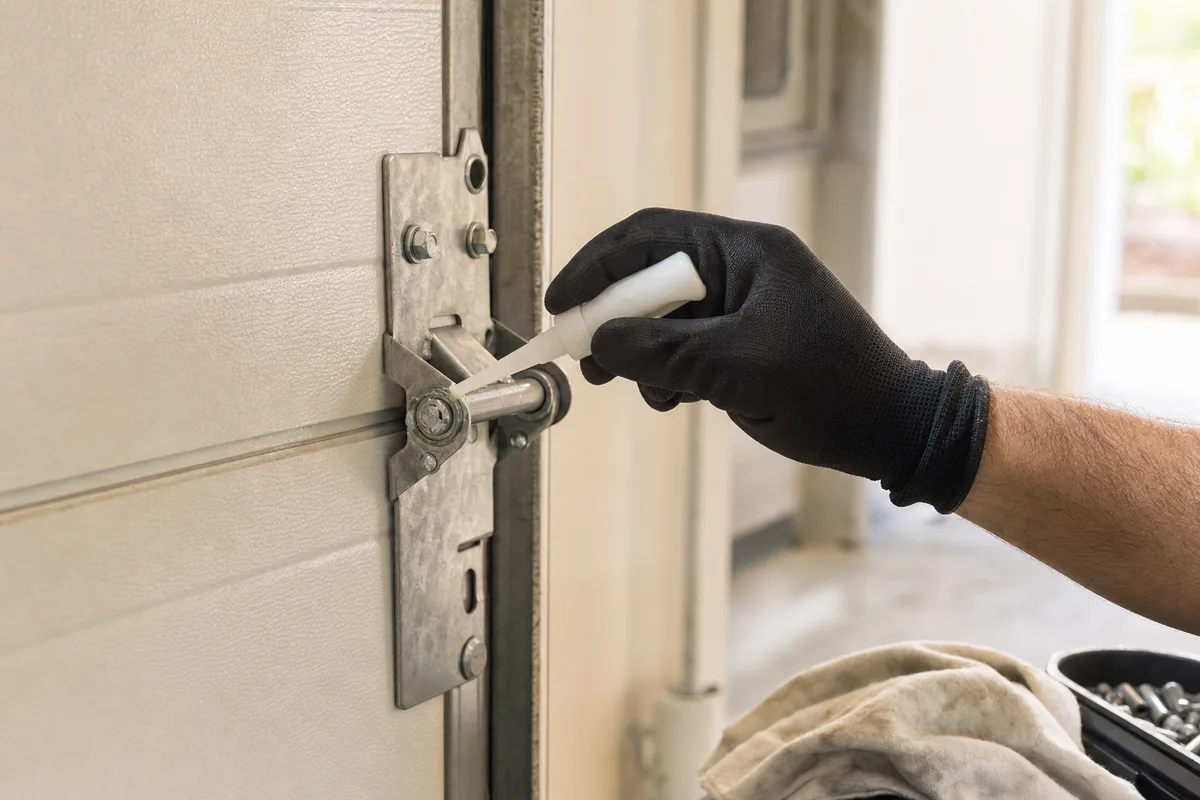
Rollers, hinges, bearings and spring coils are lubricated with the appropriate products; the track running surfaces are cleaned rather than greased, since grease there just collects grit.
Photo eye alignment, the safety reverse against an obstruction, force and travel limits, the manual release and the seals are all tested, and the household is shown the reverse test to repeat itself.
Tension and balance reset on intact springs so the door stops fighting the opener.
View detailsWorn rollers, bent track and loose brackets corrected for quiet, guided travel.
View details
Boards, limits, drive parts and safety sensors diagnosed before anything is swapped.
View detailsFill out the form and we'll confirm your appointment by email.
Garage Door Maintenance & Tune-Up is available across every Newmarket neighbourhood inside the area below.
Map data © Google. Pin shows the service area, not a walk-in location — all work is done at your home.

A real callout, not stock imagery.
A sectional door pulled off its tracks, taken down and supported on site so it could be checked and re-hung safely — photographed on the job.