Home All Services
All 10 Services
Emergency Garage Door RepairGarage Door Spring RepairGarage Door Spring ReplacementGarage Door Cable RepairGarage Door Roller & Track RepairGarage Door Opener RepairGarage Door Opener InstallationGarage Door Panel ReplacementNew Garage Door InstallationGarage Door Maintenance & Tune-Up All Service Areas
All 16 Neighbourhoods
Historic DowntownCentral NewmarketQuaker HillBristol-LondonGlenway EstatesCrossland GreenArmitageHuron HeightsLeslie ValleyGorham-College ManorSummerhill EstatesStonehaven-WyndhamCopper HillsWoodland HillBogartYonge & Davis Corridor
Troubleshooting Guides
Diagnose a Problem
Door won't closeLoud noiseBroken spring signsFrozen shutRemote not workingOff track About Book Service

Garage Door Opener Repair Newmarket

Boards, limits, drive parts and safety sensors diagnosed before anything is swapped.

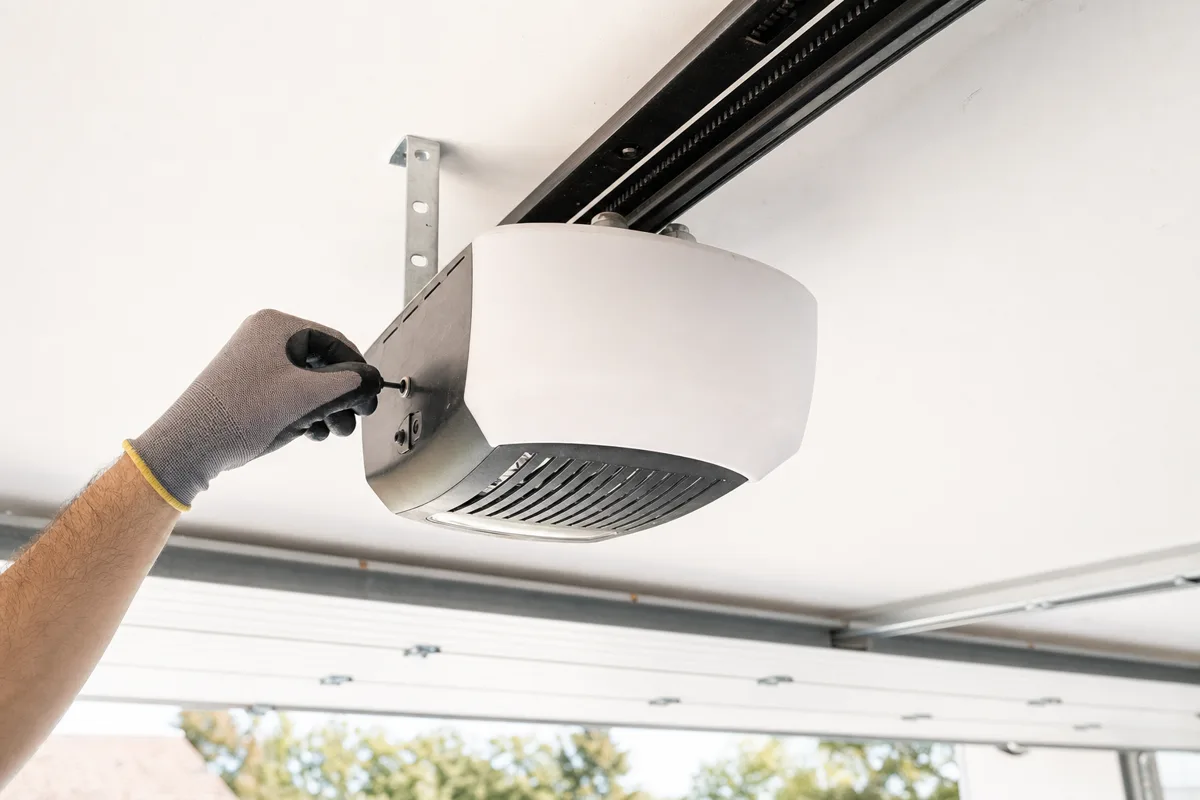
Chain-drive opener mounted to the exposed rafters of an unheated detached garage, with the rail, chain and emergency release cord visible
What's involved

Garage Door Opener Repair

An opener is a small motor, a drive system, a control board, a receiver and a pair of safety sensors, and any one of them can produce the same complaint: the door will not move properly. Repair means finding out which. A door that reverses immediately points at sensors or a closing obstruction; a motor that hums without moving the door points at the drive; a remote that works from two metres and not from the street points at the receiver or its antenna. The other possibility, and a common one, is that the opener is healthy and the door it is attached to has become too heavy.

  • Diagnosed before quotedWe identify the actual fault rather than replacing parts on assumption.
  • Confirmed by emailSubmit the form and we reply with your appointment window and details.
Symptoms

Signs You Need This Service

  • The motor runs but the door does not move.
  • The door starts down, then reverses back to fully open.
  • The wall button works but no remote does.
  • The opener stops part way and hums or clicks.
  • The unit works intermittently, worse in cold weather.

Repair or replace?

Repair is worth doing when the fault is a sensor, a gear, a board, a capacitor or a set of settings, and when parts for the model are still obtainable. It stops being worth doing on a unit old enough that parts are discontinued, or one that predates the modern safety reverse requirement, or where the repair cost approaches a new drive with a current safety circuit and rolling-code security. That is a decision the household should make with the facts in front of it, so what has failed, what parts remain available and what the alternative would involve get set out before anything is ordered.

Not sure this is your problem?

Work through the symptom first — some of these turn out to need no technician at all.

Root causes

What Actually Goes Wrong

Misaligned or dirty photo eyes

The safety sensors either side of the opening must see each other for the door to close. A knock from a bike, a bracket that has drooped, condensation or a spider web will stop the cycle and trigger a reverse.

A stripped drive gear or sheared part

Chain, belt and screw drives all have a component that gives way first. A motor that runs with no door movement usually means the drive train is no longer transmitting force, not that the motor has failed.

Force and limit settings drifting

Openers learn how much force the door needs and where travel stops. As a door gets heavier or stiffer, the settings no longer match, so the unit trips into a reverse or stops short of the floor.

Control board, receiver or wiring faults

Power surges, rodent damage to bell wire, corroded terminals and aging capacitors all produce intermittent behaviour that looks like a remote problem until the wiring is actually tested.

Local conditions

Why This Matters in Newmarket

Opener faults cluster by build era in Newmarket much as spring faults do. Summerhill Estates is 41 percent 2001 to 2005 construction and 35 percent from the 1990s, so a great many of those homes are on their original builder-supplied units or a first replacement, both now at the age where drive gears and boards give out. Cold matters too: an unheated garage in a town with a January mean near minus 7.4 degrees will stiffen the door, and an opener whose force setting was learned in mild weather may start tripping on winter mornings. Before replacing a unit, we check whether the door underneath it has simply become heavy.

Safety

What to Handle Yourself

Unplug the opener before touching the head unit, the drive or any wiring, and keep the door clear while testing. Do not disable, bypass, tape over or re-aim the photo eyes at each other on the same side to force a door to close: that safety circuit is required for a reason and defeating it puts children and pets in front of a closing door. Do not adjust force settings upward to overcome a heavy door, which is a way of hiding a spring problem behind a straining motor. Replacing a remote battery and cleaning sensor lenses are safe homeowner tasks.

The visit

How We Work Through It

  1. Separate door from opener

    The opener is disconnected and the door tested by hand. If the door is heavy or unbalanced, that is the fault, and no amount of opener work will fix it durably.

  2. Test the safety circuit

    Photo eye alignment, lens condition, indicator lights and the wiring back to the head unit are checked, along with the safety reverse against an obstruction on the floor.

  3. Inspect drive and controls

    The gear, sprocket, chain or belt, trolley, rail and door arm are examined for wear or shear, and the logic board, capacitor, receiver and terminal connections are tested rather than guessed at.

  4. Repair, reset and verify

    Failed parts are replaced where parts remain available, force and travel limits are reset to the door's actual weight, remotes and keypad are re-paired, and the whole cycle is tested including the reverse.

Related services

You Might Also Need

Newly installed opener on a garage ceiling, wall-to-ceiling mounting brackets in place and the rail and door arm connected to the top section

Garage Door Opener Installation

Operators matched to the door weight and the ceiling you actually have.

View details
Centre bearing bracket and the end of a torsion spring on a residential garage door, the shaft seated in its bearing and the bracket bolted back to the header

Garage Door Spring Repair

Tension and balance reset on intact springs so the door stops fighting the opener.

View details
Gloved hand steadying the curved track at the flag bracket during a maintenance visit

Garage Door Maintenance & Tune-Up

A pre-winter inspection and adjustment that catches wear before a January morning does.

View details
Questions

Garage Door Opener Repair FAQs

My door reverses as soon as it touches the floor. Why?
Two likely reasons. Either the down travel limit is set slightly too low, so the opener keeps driving after the door has landed and reads the resistance as an obstruction, or the close force is set too tight for a door that has become stiffer. Both are adjustments rather than parts. A third possibility is something on the floor the sensors are catching, including a build-up of ice at the threshold. We check the sensors and the door weight before touching the settings, since raising force to mask a heavy door is exactly the wrong move.
Should I repair an old opener or replace it?
It depends on the failed part and on the unit’s age. A photo eye, a gear kit, a capacitor or a receiver on a serviceable unit is usually a sensible repair. A discontinued board on a twenty-year-old head unit is not, because the next failure has no fix either. Openers old enough to lack a working safety reverse or rolling-code remotes are worth replacing on those grounds alone. We tell you which category yours is in and what parts availability looks like, then leave the choice with you.
The opener hums but the door stays put. What is that?
That pattern almost always means the drive train has failed rather than the motor. On a chain or belt unit the plastic drive gear is the usual culprit; it strips, so the motor spins freely without turning the sprocket. On a screw drive the trolley or the coupler is the equivalent. It can also mean the trolley has been released from the door arm, in which case reconnecting it is all that is needed. The distinction is easy to confirm on site and determines whether this is a small part or a bigger job.
Why do my remotes fail in winter but work in summer?
Battery chemistry is the most common answer: a coin cell or nine-volt battery loses usable output in the cold, and a remote left in a car overnight at minus fifteen may not have the power to reach the receiver. Beyond that, cold shrinks tolerances in the door, so the opener draws more force and may trip out before the door completes travel, which reads as a remote failure. Start with fresh batteries, then have the door balance and the receiver checked if it persists.

Book Garage Door Opener Repair

Fill out the form and we'll confirm your appointment by email.

We confirm every request by email, usually the same day it arrives.

  • Proudly Canadian
  • Same-day service available
  • 16 Newmarket communities
  • Every request confirmed by email
Request received. We'll email you a confirmed time window shortly.
Service area

Where We Work

Garage Door Opener Repair is available across every Newmarket neighbourhood inside the area below.

Map data © Google. Pin shows the service area, not a walk-in location — all work is done at your home.

Sectional garage door dropped off its tracks and leaning inward, held on a stepladder during a night call-out, with the driveway lit beyond the opening
From the tools

A real callout, not stock imagery.

A sectional door pulled off its tracks, taken down and supported on site so it could be checked and re-hung safely — photographed on the job.