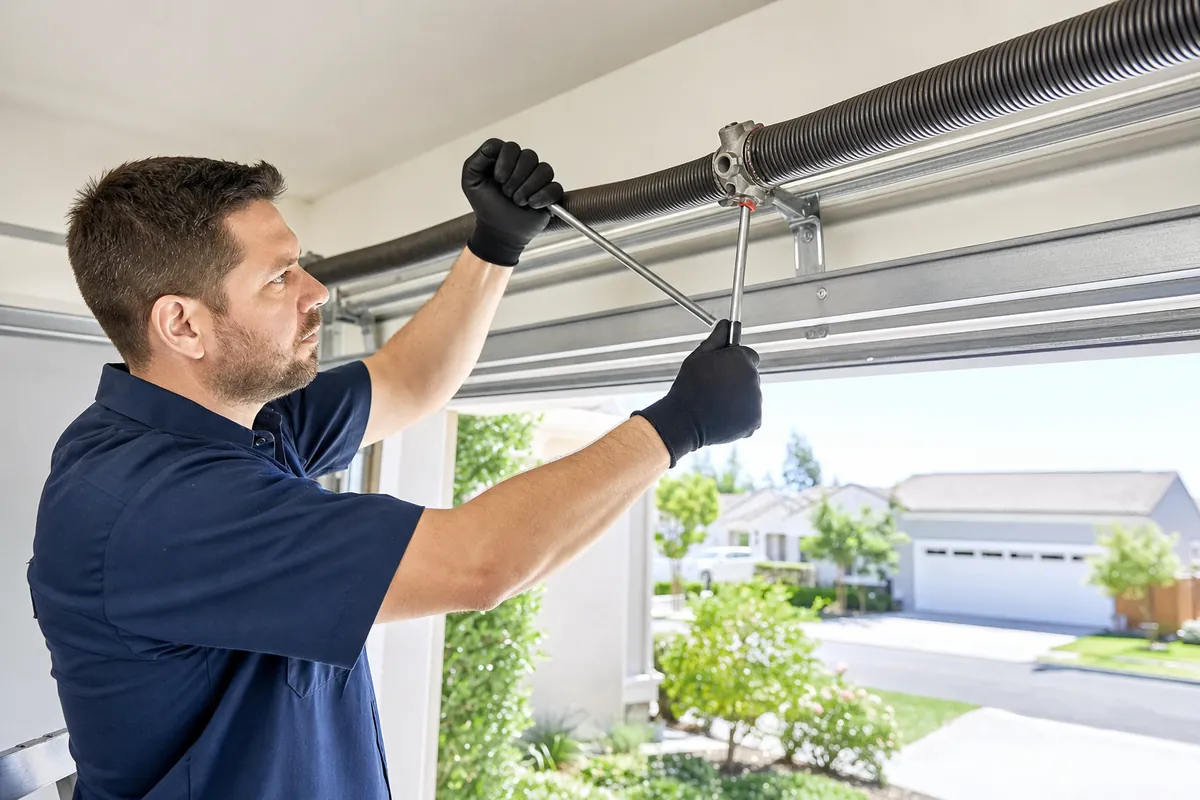

Garage Door Spring Replacement
Broken or fatigued springs replaced as a matched pair and re-tensioned to the door.
View detailsTension and balance reset on intact springs so the door stops fighting the opener.

Not every spring problem is a broken spring. A door that has become heavy to lift by hand, drifts back down when left half open, creeps up off the floor, or lifts unevenly usually has springs that are intact but no longer holding the tension the door needs. That is an adjustment job rather than a parts job: tension reset with winding bars, the cable drums re-wound so both sides match, and the bearings, shaft and end brackets serviced. Balance is the whole point. A correctly balanced door stays roughly where you leave it anywhere in its travel, and an opener attached to one lasts far longer.
Re-tensioning restores a spring that has relaxed; it cannot restore one that has fatigued to the point of cracking or has lost coil integrity. Springs are rated in cycles rather than years, so a two-car household using the door six times a day gets through its rating far faster than a household using it twice. The honest test on site is whether the spring holds the adjustment: if tension has to be added repeatedly, the wire is tired and replacement is the durable answer. Where a spring was previously mis-sized, adjustment can only ever partly compensate, and that gets said rather than papered over.
Work through the symptom first — some of these turn out to need no technician at all.
Torsion springs relax gradually across thousands of cycles. Nothing breaks, but the counterbalance drops away and the door gets progressively heavier, which the household usually notices only once the opener starts labouring.
A spring sized to the wrong wire, length or inside diameter will never balance the door properly. It is a common finding on houses where a spring was replaced once, cheaply, years ago.
If the cables are not seated with equal wraps on both drums, one side lifts ahead of the other. The springs may be perfectly good while the door still travels out of level.
Fitting a heavier insulated section, adding a strut, or a section that has absorbed water all change what the springs are being asked to hold. The original tension is then simply wrong for the door.
Balance loss shows up in clusters here, because Newmarket built in waves. Quaker Hill went up between 1967 and 1977, Woodland Hill is 52 percent 2006 to 2010, Glenway is 54 percent 1981 to 1990 and Copper Hills finished its last big phase in 2017. Doors installed within a few years of each other, in households that use the garage as the main entrance, reach the same cycle count at roughly the same time, which is why one street can generate several heavy-door complaints in one season. The town's density, third among Ontario census subdivisions, means those streets are close together. If a neighbour's spring has just gone, a balance check on yours is a reasonable move.
A torsion spring holds enough stored energy to cause serious injury, and adjusting one needs correctly sized winding bars and a controlled sequence. Screwdrivers, rebar, drill bits and pliers are how people get hurt. Do not attempt to wind or unwind a spring, do not stand under a spring you are working near, and do not loosen a set screw on a winding cone to see what happens. Testing balance by hand with the opener disconnected is safe and useful. Everything past that point belongs to someone with the bars and the practice to use them.
With the opener disconnected, the door is lifted by hand and tested at several heights to see where it holds, where it drifts and whether one side leads. That tells us whether this is a tension job or a parts job.
Springs are checked for coil gaps, corrosion and previous mis-sizing; the shaft, centre bearing, end bearing plates and anchor backing are checked for wear and for whether they are fixed into sound structure.
Tension is adjusted with proper winding bars, never improvised tools, and the cable drums are re-wound so both sides carry equal wraps. Small increments, tested between each one, rather than one large guess.
The door is retested by hand for hold and level travel, and only then is the opener reconnected and its force and limit settings reviewed against the door's new, lighter behaviour.
Broken or fatigued springs replaced as a matched pair and re-tensioned to the door.
View details
A pre-winter inspection and adjustment that catches wear before a January morning does.
View details
Boards, limits, drive parts and safety sensors diagnosed before anything is swapped.
View detailsFill out the form and we'll confirm your appointment by email.
Garage Door Spring Repair is available across every Newmarket neighbourhood inside the area below.
Map data © Google. Pin shows the service area, not a walk-in location — all work is done at your home.

A real callout, not stock imagery.
A sectional door pulled off its tracks, taken down and supported on site so it could be checked and re-hung safely — photographed on the job.