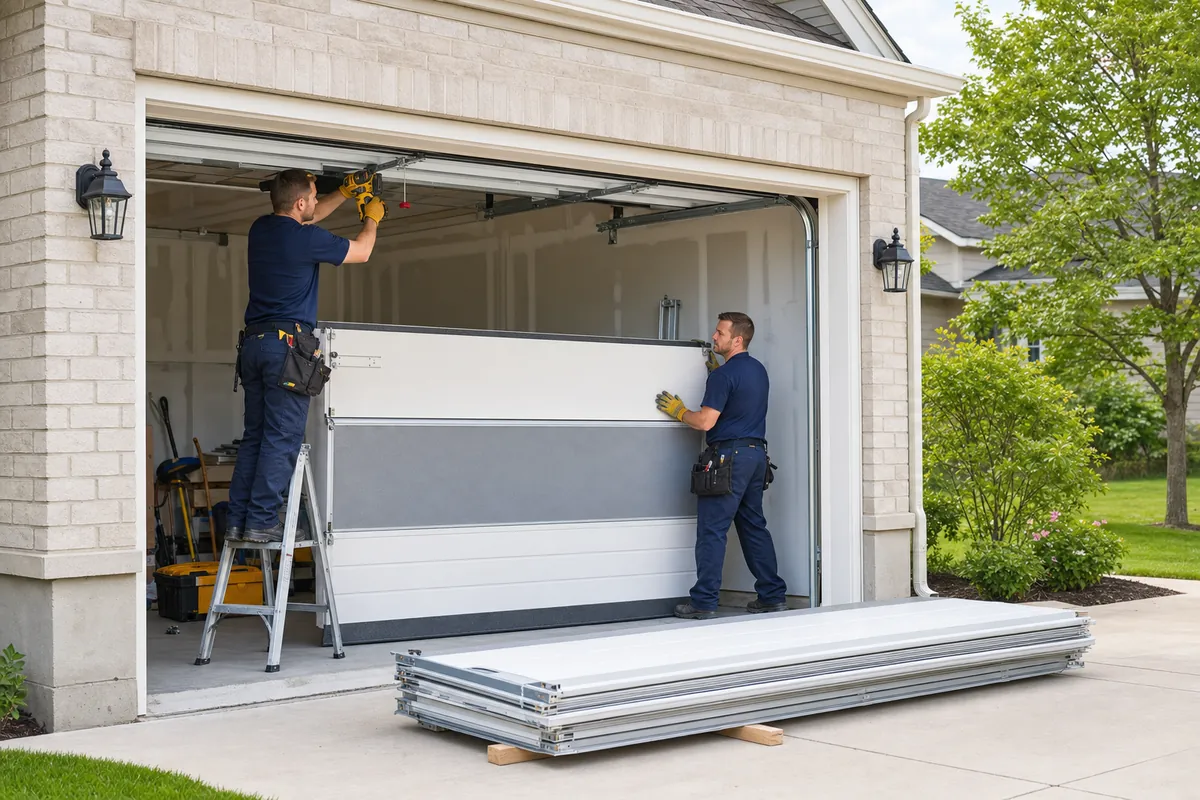

Garage Door Panel Replacement
Damaged sections matched to your existing door, or repaired where the steel is sound.
View detailsDoors measured to the opening in front of us, heritage streets and narrow lots included.

A new door is the one garage decision that is both structural and visible from the street. Getting it right means measuring the opening properly, including headroom, backroom and the sideroom the track needs; choosing construction that suits the garage, insulated where the space is attached or heated, and specifying the correct spring system for the finished weight. Then it is installation quality: track plumb and square, brackets into sound framing, seals that actually meet the slab, and a door balanced by hand before an opener is asked to touch it.
A well-specified door installed square, on springs sized to its weight, with sealed rollers and good seals, is a long-service item, and the parts that wear out on it are the ones designed to be replaced. What shortens that life is predictable: springs sized to the old door, track fixed into unsound framing, no threshold seal on a slab that collects meltwater, and an opener set to force the door rather than guide it. Insulated construction also does more than retain heat, because a stiffer, quieter panel is simply better to live with in a garage under a bedroom.
Our troubleshooting guides walk the diagnostic checks in order so you can confirm the fault before booking.
Once several sections are dented or corroded and the hardware has been repaired repeatedly, further section work stops being value. Replacement resets the whole assembly at once.
An attached garage sharing a wall and a ceiling with heated rooms loses real heat through an uninsulated door. Insulated construction with proper perimeter and threshold seals changes how the space behaves.
On many houses the garage door is the largest single element facing the street, so its style, colour and glazing carry disproportionate weight in how the house reads.
Older detached garages and converted structures rarely present a tidy standard size. Doors have to be specified to the opening actually measured, not to a catalogue width.
Newmarket presents the full range in a small town. In the Old Town around Main Street South, nineteenth-century houses sit on compact lots with detached rear garages reached by narrow laneways and side drives, so openings are often non-standard, headroom is short and the turn from the street is tight; on designated properties the Town's heritage permit scope can include erecting a new garage or a new facade, so confirm before ordering. In Copper Hills, where the last phase of one hundred and fifty-four detached homes on forty to fifty-two foot lots completed in 2017, and in Woodland Hill, where nothing predates 1991, the questions are different: wide insulated doors, matching an established streetscape, and specifying springs for the real weight.
New door installation includes winding a torsion spring system to the finished door's weight, which is the part that makes it a trade job rather than a weekend one. Once the door is in, the household should know where the release cord is, how to test the safety reverse, and to keep the wall control out of children's reach. Where a garage forms part of the fire separation from the house, the door between garage and dwelling and the surrounding construction have their own requirements. Permit questions, especially on designated heritage properties, should be confirmed with the Town rather than assumed.
Width, height, headroom, backroom, sideroom, the condition of the jambs and header, floor level and the power supply are all recorded, because these determine what can actually be fitted.
Construction, insulation value, panel style, glazing and colour are chosen with the finished weight in mind, and the spring system is sized to that weight rather than to the door being removed.
The old door and its hardware are taken out under controlled spring tension, jambs and header are checked for sound fixing, and any preparation needed is dealt with before the new door goes up.
Sections are set plumb and square, track and brackets fixed into framing, perimeter and bottom seals fitted, the door balanced by hand, then the opener set and the safety reverse tested with the household present.
Damaged sections matched to your existing door, or repaired where the steel is sound.
View details
Operators matched to the door weight and the ceiling you actually have.
View details
Broken or fatigued springs replaced as a matched pair and re-tensioned to the door.
View detailsFill out the form and we'll confirm your appointment by email.
New Garage Door Installation is available across every Newmarket neighbourhood inside the area below.
Map data © Google. Pin shows the service area, not a walk-in location — all work is done at your home.

A real callout, not stock imagery.
A sectional door pulled off its tracks, taken down and supported on site so it could be checked and re-hung safely — photographed on the job.